Homelab-Ops: Sovereign Cloud Infrastructure & GitOps Platform










Executive Overview: The Project at a Glance
Homelab-Ops is a production-grade, self-healing Sovereign Cloud Platform engineered on physical bare-metal hardware in Mumbai, India, integrated with supporting cloud infrastructure in Oracle Cloud Infrastructure (OCI) and Google Cloud Platform (GCP).
This platform simulates enterprise-scale infrastructure engineering while operating under strict real-world constraints:
- Carrier-Grade NAT (CGNAT) Traversal: Securely accepting external webhooks and public user traffic without exposing home router ports or relying on static IPv4 leasing.
- Deterministic GitOps Continuous Delivery: Managing platform operators and applications declaratively with Flux CD v2 and Mozilla SOPS, eliminating configuration drift and keeping secrets versioned safely in Git.
- Dual-Tier Hardware Economics: Overcoming disk I/O bottlenecks on a single Mini PC by partitioning high-IOPS NVMe flash for database engines and durable SATA mechanical disks for multi-terabyte media and document archives.
- Hybrid Multi-Cloud Resilience: Supplementing the on-premise sovereign cluster with cloud infrastructure across Oracle Cloud Infrastructure (OCI) and Google Cloud Platform (GCP) for out-of-band availability monitoring, remote state locking, and secondary cloud compute.
Architecture & System Design
High-Level Platform Topology
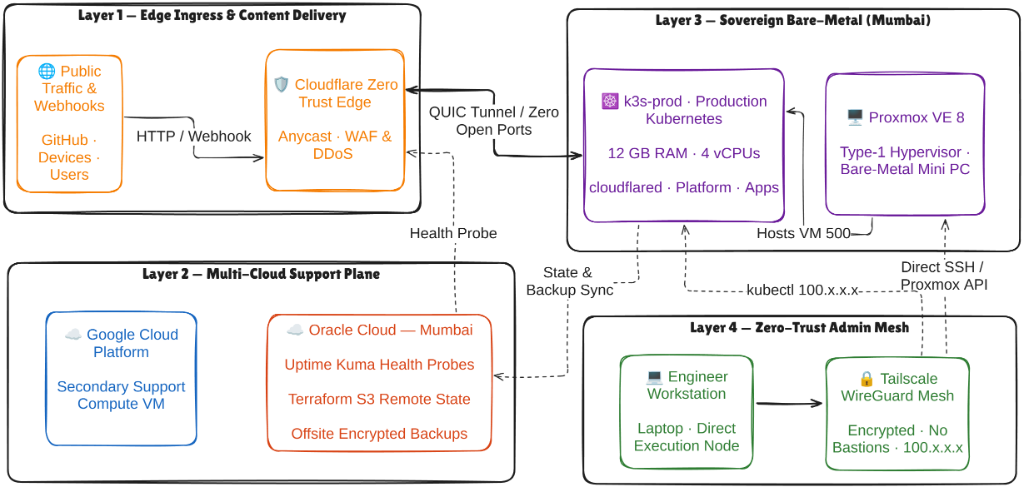
The interactive topology below illustrates how external client traffic enters through Cloudflare Zero Trust, reaches the sovereign bare-metal cluster via outbound QUIC tunnels, and connects to persistent databases and multi-cloud resilience monitors:
graph TD
    classDef edge fill:#0f172a,stroke:#06b6d4,stroke-width:2px,color:#f8fafc;
    classDef cluster fill:#1e293b,stroke:#8b5cf6,stroke-width:2px,color:#f8fafc;
    classDef cloud fill:#0284c7,stroke:#38bdf8,stroke-width:2px,color:#ffffff;
    classDef storage fill:#334155,stroke:#e2e8f0,stroke-width:1px,color:#f8fafc;

    subgraph Internet_Edge["Global Anycast Edge"]
        User["Public Client / Webhook"]:::edge -->|HTTPS / <15ms| CF["Cloudflare Zero Trust Edge"]:::edge
    end

    subgraph Bare_Metal["Sovereign Bare-Metal (Mumbai, India)"]
        CF -->|Outbound QUIC Tunnel| Tunnel["cloudflared Connector"]:::cluster
        Tunnel --> Traefik["Traefik Ingress Controller"]:::cluster

        Traefik --> AppFleet["Application Fleet (n8n, Paperless, BookOrbit, Ryot)"]:::cluster
        AppFleet --> CNPG["CloudNativePG PostgreSQL Cluster"]:::cluster

        CNPG --> NVMe[("Tier 1: 256GB NVMe Flash")]:::storage
        AppFleet --> SATA[("Tier 2: 1TB SATA HDD")]:::storage

        Flux["Flux CD v2 Controller"]:::cluster -.->|Reconciles State| AppFleet
        GitRepo[("GitHub GitOps Repository")]:::edge -.->|Git Pull| Flux
    end

    subgraph Multi_Cloud["Hybrid Cloud Resilience"]
        Kuma["OCI Mumbai (Uptime Kuma)"]:::cloud -->|Public Health Probes| CF
        Kuma -.->|Alerts| Discord["Discord / Slack Webhooks"]:::cloud
    end
The platform architecture is organized into three distinct structural diagrams:
1. Global Multi-Cloud & Network Ingress Topology
How external traffic, edge security, multi-cloud support, and the secure administrative mesh are organized:
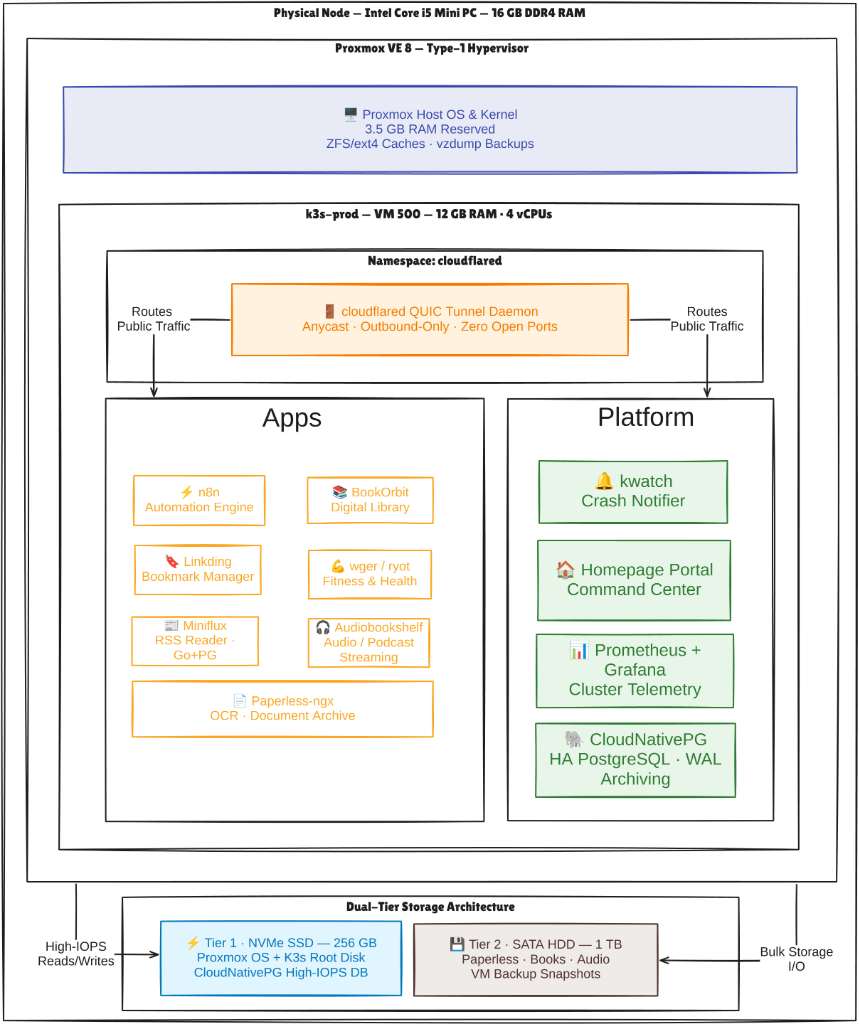
2. Sovereign Bare-Metal & Cluster Architecture
How physical hardware, hypervisor resource fencing, and tiered storage are partitioned:
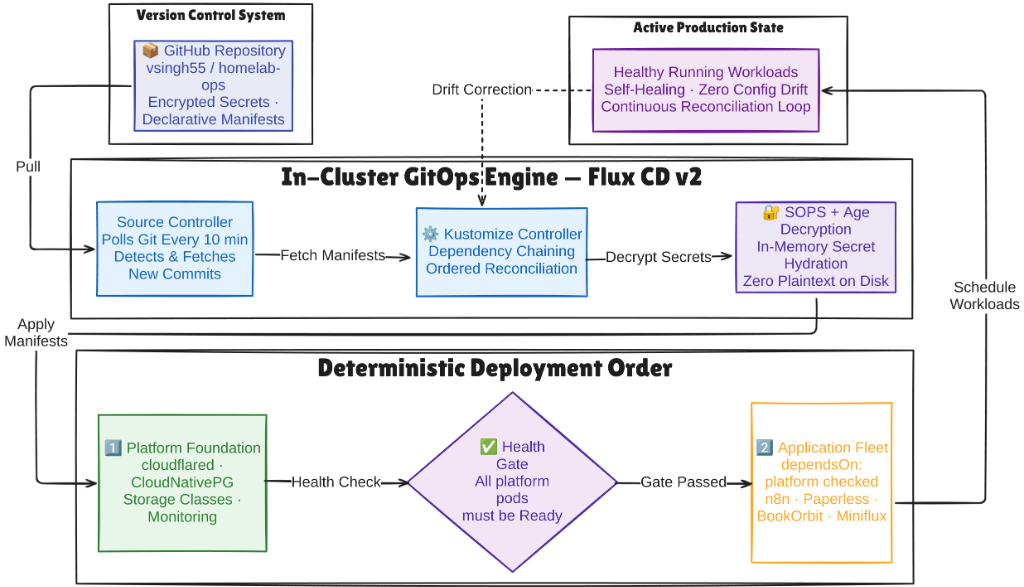
3. Declarative GitOps & Secret Lifecycle Pipeline
How code changes flow automatically from Git into production without configuration drift:
The Engineering Story: From Bare Metal to Sovereign GitOps
Act I: The Bare-Metal Foundation
Every robust platform begins with physical constraints. The on-premise foundation is an ultra-efficient Intel Core i5 Mini PC with 16GB DDR4 RAM, a 256GB NVMe SSD, and a 1TB SATA mechanical drive.
To convert this single machine into an enterprise platform, Proxmox VE 8 was chosen as the Type-1 hypervisor. By budgeting host resources strictly—reserving 3.5GB of RAM for the Debian kernel, memory caching, and backup snapshot compression—a dedicated virtual machine (k3s-prod) was allocated 12GB RAM and 4 vCPUs, ensuring high memory headroom for Kubernetes workloads while safeguarding the physical host against out-of-memory (OOM) kernel panics.
Act II: Conquering the Network (Zero Trust Ingress)
Residential internet connections rarely provide static public IP addresses and are almost universally bound behind Carrier-Grade NAT (CGNAT), making traditional port-forwarding impossible or insecure.
- The Evolution: Early iterations explored cloud gateway relays. While functional, routing cross-continental traffic introduced latency hops and incurred ongoing NAT maintenance.
- The Production Standard: The platform upgraded to Cloudflare Zero Trust Anycast Tunnels (
cloudflared). Operating as an in-cluster deployment,cloudflaredinitiates outbound-only QUIC connections to Cloudflare's nearest edge data centers (Mumbai, Delhi, Chennai). Public webhooks and traffic terminate at the edge in <15ms, protected by Cloudflare WAF and DDoS mitigation, with zero open inbound ports on the home firewall.
Act III: GitOps Continuous Delivery & In-Git Secrets
Operating infrastructure through manual kubectl apply commands or ad-hoc scripts leads to configuration drift and operational opacity.
The modern platform runs on pure GitOps Continuous Delivery powered by Flux CD v2:
- The cluster continuously synchronizes its desired state from this Git repository.
- Workload reconciliation is deterministically ordered: platform foundations (storage classes, operators, ingress daemons) must report healthy before application workloads are scheduled (
appsdepends onplatform). - Sensitive tokens and database passwords are encrypted declaratively using Mozilla SOPS + Age. Because secrets remain encrypted in Git, they can be safely reviewed in pull requests, while the in-cluster Flux decryptor hydrates them into memory without leaving plaintext traces on physical disks.
Act IV: Storage Economics & Stateful High Availability
Single-node virtualization often stumbles when high-IOPS database queries compete with heavy background disk writes:
- Storage Tiering: Fast NVMe storage is dedicated strictly to the OS, K3s state, and PostgreSQL data files. Multi-terabyte document indexing (Paperless-ngx) and audio/book streaming libraries are routed directly to the high-capacity 1TB SATA mechanical disk.
- Database Modernization: Rather than deploying fragile, static database pods, relational data is managed by the CloudNativePG Operator. The operator provides automated PostgreSQL lifecycle management, health monitoring, self-healing failover, and Write-Ahead Log (WAL) archiving.
Act V: Multi-Cloud Resilience (Oracle Cloud & Google Cloud Support)
A monitoring system running inside the cluster it is supposed to monitor cannot alert you when the cluster itself dies. Furthermore, local backups are vulnerable if the physical host suffers hardware failure.
To achieve enterprise-grade resilience, the architecture integrates Oracle Cloud Infrastructure (OCI) and Google Cloud Platform (GCP) support instances:
- Out-of-Band Health Probes: An independent cloud VM in OCI Mumbai runs Uptime Kuma, continuously polling public endpoints over the public internet and dispatching alerts to Slack/Discord if homelab broadband or power fails.
- Remote State & Offsite Backup: Terraform state is stored securely with remote locking in an OCI Object Storage S3-compatible backend, and nightly encrypted Restic backups are pushed offsite, fulfilling the 3-2-1 backup rule (3 copies, 2 media types, 1 offsite).
- Multi-Cloud Compute Support: Supporting cloud virtual machines across OCI and GCP provide compute targets for auxiliary services and remote operations.
Core Architecture Pillars
| Architectural Pillar | Core Technologies | How It Solves the Problem |
|---|---|---|
| Zero-Trust Edge & Ingress | Cloudflare Zero Trust, cloudflared, Traefik |
Traverses CGNAT with outbound-only QUIC tunnels; provides edge WAF and reduces latency to <15ms with zero open router ports. |
| GitOps Continuous Delivery | Flux CD v2, Kustomize, GitHub | Pull-based reconciliation loop eliminates configuration drift; deterministic ordering ensures zero failed boots. |
| In-Git Secret Decryption | Mozilla SOPS, Age Cryptography | Secrets versioned declaratively in Git with asymmetric encryption; decrypted exclusively in-memory by Flux. |
| Dual-Tier Storage Strategy | NVMe Flash (256GB), SATA Mechanical (1TB) | Isolates high-IOPS database operations from bulk document indexing and media streaming workloads. |
| Stateful Resilience & HA | CloudNativePG (PostgreSQL Operator) | Self-healing relational database clustering with automated failover and continuous WAL archiving. |
| Multi-Cloud Support Plane | OCI Mumbai, GCP Support VM, Uptime Kuma | Independent external heartbeat monitoring and remote state locking; operates even during power or ISP outages. |
Application Fleet & Workload Catalog
All services are containerized, declared in Git, and routed through Cloudflare Zero Trust:
Platform & Security
├── cloudflared             # High-availability Anycast edge ingress tunnel
├── postgres-operator       # CloudNativePG enterprise PostgreSQL lifecycle operator
├── homepage                # Homelab Command Center (Live CPU/RAM & status portal)
├── monitoring              # Prometheus metrics scraping & Grafana telemetry
├── kwatch                  # Instant Discord/Slack notifier for crashed pods
└── docs                    # MkDocs Material engineering handbook (docs.vijaysingh.cloud)

Operations & Workflow Automation
├── n8n                     # Hardened event-driven workflow automation engine
└── pdf-generator           # Automated document compilation microservice

Sovereign Documents & Media (1TB HDD Tier)
├── paperless-ngx           # OCR document ingestion, tagging, and search archive
├── bookorbit               # Multi-user digital book library & sync manager
└── audiobookshelf          # Audiobook and podcast streaming server

Productivity & Personal Health
├── miniflux                # Ultra-fast, lightweight Go RSS reader
├── linkding                # Bookmarking service with tag search
└── ryot / wger             # Fitness analytics and workout tracking platform
Physical Hardware & Resource Budgeting
| Resource Domain | Allocated Hardware | Role & Engineering Purpose |
|---|---|---|
| Host System RAM | 16,384 MB (16 GB) DDR4 | 12GB to k3s-prod, 3.5GB to Proxmox VE 8 host OS, 0.5GB emergency buffer. |
| Compute Core Budget | Intel Core i5 (4C / 8T) | 4 vCPUs dedicated to Kubernetes container scheduling and OCR worker spikes. |
| Tier 1: Hot NVMe Flash | 256GB PCIe M.2 SSD | ~20GB Proxmox host root, 50GB VM root, CloudNativePG active database tables. |
| Tier 2: Cold Mechanical | 1TB 2.5" SATA HDD | Attached storage for Paperless archives, BookOrbit media, and VM snapshots. |
Standard Engineering Documentation & Enterprise Handbook
Following CNCF and enterprise platform standards, all architecture specifications, flagship project case studies, and incident post-mortems are documented in the sections below:
1. Production System Architecture (Single Source of Truth)
- 01. System Architecture Overview — High-level multi-cloud hybrid topology, design goals, and component boundaries.
- 02. Hardware & Virtualization — Bare-metal Mini PC specifications and Proxmox VE 8 memory fencing.
- 03. Kubernetes & K3s Cluster — Single-node production K3s cluster architecture and namespaces.
- 04. Zero-Trust Networking — Cloudflare Zero Trust Anycast Tunnels and Tailscale administrative mesh.
- 05. Dual-Tier Storage Strategy — Partitioning high-IOPS NVMe flash from bulk mechanical SATA storage.
2. Featured Projects & Case Studies
- Case Study: Zero-Trust Hybrid Ingress Engine — CGNAT traversal, Anycast edge routing, WAF, and <15ms latency.
- Case Study: Declarative GitOps & In-Git Secrets — Continuous delivery via Flux CD v2 and Mozilla SOPS + Age encryption.
- Case Study: Stateful PostgreSQL Operator on Bare-Metal — CloudNativePG high-availability operator, automated failover, and WAL archiving.
- Case Study: Multi-Cloud Resilience & Out-of-Band DR — OCI Mumbai & GCP support compute, Uptime Kuma external probes, and 3-2-1 backup replication.
3. Architecture Decision Records (ADRs)
- Comprehensive ADR Register — 16 formal Architecture Decision Records documenting every pivotal architectural decision (ADR-001 through ADR-016), following the Michael Nygard standard.
4. Operations & Runbooks
- Backup & Disaster Recovery Runbook — Procedures for 3-2-1 backup verification and bare-metal disaster recovery.
- Day-2 Cluster Operations Runbook — SOPS secret rotation, manual GitOps reconciliation, and host maintenance.
- Incident Response & Triage Playbook — Emergency diagnostic workflows, P0–P3 severity triage, and automated failover playbooks.
5. Infrastructure Modernization & Execution Phases
- Execution Master Index — Comprehensive 7-phase execution records detailing the migration from legacy multi-bastion lab to single-node sovereign cloud.
- 01. Architecture Baseline & 02. Codebase Pruning
- 03. Remote State Migration & 04. Hypervisor Consolidation
- 05. Edge Ingress & Registry & 06. GitOps & SOPS Secrets
- 07. Fleet Deployment & ChatOps
6. Historical Archive & Incident Post-Mortems (v1.0 & v2.0 Milestones)
- Engineering Archive Overview — Historical milestones, early technical challenges, and iterative migrations leading to v3.0.
- Bare-Metal Boot Failure Post-Mortem & WAN Connectivity Post-Mortem
- Ansible Automation Journey & Terraform Modularization
- Hybrid Cloud Automation Journal (n8n) & Self-Healing Watchdog
Quick Operator Runbook
Secret Encryption Workflow (SOPS + Age)
# Encrypt an updated Kubernetes Secret manifest before committing to Git
sops --encrypt --in-place kubernetes/apps/n8n/secret.enc.yaml

# Directly edit an encrypted secret file using your default editor
sops kubernetes/apps/n8n/secret.enc.yaml
GitOps Synchronization
# Force immediate reconciliation of the platform layer
flux reconcile kustomization platform --with-source

# Force immediate reconciliation of the application layer
flux reconcile kustomization apps --with-source
Out-of-Band Host Administration (Tailscale Mesh)
# Direct SSH access to the Proxmox VE hypervisor
ssh root@[IP_ADDRESS]

# Direct SSH access to the Production K3s node
ssh devops@[IP_ADDRESS]

# Inspect active Cloudflare tunnel connections
kubectl logs -n platform -l app.kubernetes.io/name=cloudflared --tail=50
Portfolio & Engineering Profiles
Vijay Kumar Singh — DevOps & Platform Engineer
- Portfolio: https://vijaysingh.cloud
- GitHub: @vsingh55
- GitHub Projects Portfolio: https://gh.showcase.vijaysingh.cloud
- Documentation Portal: https://docs.vijaysingh.cloud
- Homelab Homepage: https://hub.vijaysingh.cloud
- Observability & Monitoring: http://telemetry.vijaysingh.cloud
- System Status & Uptime: https://status.vijaysingh.cloud
Engineered with precision, operational discipline, and pride in sovereign platform engineering.