04. Zero-Trust Networking & Edge Ingress Architecture
Platform Standard: Zero-Trust Ingress & Anycast Edge Traversal
Ingress Protocol: Outbound QUIC Multiplexed Tunnels (HTTP/3 over UDP)
Administrative Mesh: Tailscale Peer-to-Peer Encrypted WireGuard Fabric
Firewall Posture: Strictly Zero Inbound Ports Open on Home Router
1. The Core Networking Challenge: Carrier-Grade NAT (CGNAT)
Residential Internet Service Providers (ISPs) universally assign non-routable private IPv4 addresses from the RFC 6598 Shared Address Space (100.64.0.0/10) behind Carrier-Grade NAT (CGNAT):
[ On-Premise Host ]
         |
[ Home Wi-Fi Router ] (Private 192.168.1.1)
         |
[ ISP CGNAT Gateway Pool ] (RFC 6598 100.64.x.x) --> Shared across thousands of homes
         |
[ Public Internet ]
Architectural Implications of CGNAT:
- Port Forwarding is Impossible: The subscriber does not control a public IPv4 address. Traditional router NAT port-forwarding (e.g., exposing ports 80/443 to a local server) cannot be routed by the ISP.
- Dynamic Leases: Public IPs rotated by ISPs break standard static DNS configurations.
- Attack Surface Minimization: Even if a static IP was leased at high commercial cost, exposing a residential IP address directly to the internet invites automated port scanning, credential brute-forcing, and volumetric DDoS attacks.
2. Ingress Architecture: Cloudflare Zero Trust Anycast Tunnels
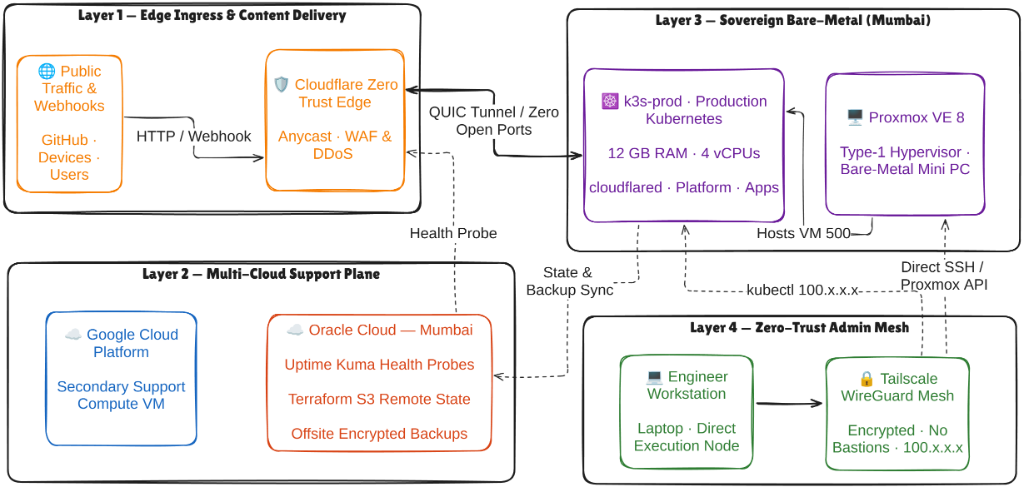
To solve the CGNAT barrier without paying for business leased lines or running fragile public cloud proxy relays, all public internet traffic traverses Cloudflare Zero Trust Anycast Tunnels:
flowchart LR
    subgraph PublicInternet["Public Internet"]
        User["User Browser / Webhook"]
    end

    subgraph CF_Anycast["Cloudflare Global Anycast Edge (Mumbai / Delhi / Chennai)"]
        EdgeDNS["DNS (vijaysingh.cloud)"]
        WAF["Edge WAF & DDoS Shield"]
        EdgeTerm["SSL Termination (TLS 1.3)"]
    end

    subgraph OnPremCluster["On-Premise K3s Cluster"]
        CF_Daemon["cloudflared Daemon\n(Outbound QUIC Tunnel)"]
        Traefik["Traefik Ingress Controller"]
        Services["Kubernetes Services & Pods"]
    end

    User -->|HTTPS| EdgeDNS
    EdgeDNS --> WAF
    WAF --> EdgeTerm
    EdgeTerm <==|Encrypted QUIC (Outbound Only)|==> CF_Daemon
    CF_Daemon --> Traefik
    Traefik --> Services
Architectural Properties:
- Outbound-Only Connection: The in-cluster
cloudflareddaemon establishes and maintains outbound QUIC connections to the nearest Cloudflare Anycast edge PoP (Mumbai, Delhi, Chennai). The local home router allows outbound UDP traffic while keeping 100% of inbound ports closed. - Edge Security & WAF: Incoming requests are inspected, sanitized, and filtered against OWASP Top 10 vulnerabilities at Cloudflare's edge before ever reaching the on-premise cluster.
- Ultra-Low Latency: Edge termination occurs at local data centers within India, delivering sub-15ms round-trip response times for local clients.
3. Administrative Plane: Tailscale Encrypted Mesh
While public traffic arrives through Cloudflare, all operational administration is isolated into an out-of-band Zero-Trust Administrative Mesh powered by Tailscale:
flowchart TD
    Workstation["Administrator Laptop\n(Remote WAN or LAN)"]
    AuthPlane["Tailscale Coordination Server\n(Google Workspace MFA / SSO)"]
    HypervisorNode["Proxmox VE Host\n(100.108.178.93)"]
    K3sNode["k3s-prod Workload VM\n(100.x.x.x)"]

    Workstation -. "1. Authenticates Identity" .-> AuthPlane
    AuthPlane -. "2. Exchanges WireGuard Public Keys" .-> Workstation
    Workstation <==|3. Direct P2P Encrypted WireGuard|==> HypervisorNode
Workstation <==|3. Direct P2P Encrypted WireGuard|==> K3sNode- Identity-First Access: Access is authenticated against Google Workspace Single Sign-On (SSO) with hardware Multi-Factor Authentication (MFA).
- Direct P2P Execution: Eliminates intermediate jumpbox/bastion hosts.
kubectl, SSH, and Ansible execute directly from the engineer's workstation with end-to-end WireGuard encryption. - NAT Traversal (STUN / DERP): Tailscale automatically establishes direct peer-to-peer UDP connections using STUN hole-punching, falling back to encrypted DERP relay servers only if symmetric NAT prevents direct peering.
4. Dual-Plane Comparison: Ingress vs. Administration
| Dimension | Public Ingress Plane | Administrative Management Plane |
|---|---|---|
| Technology | Cloudflare Zero Trust Tunnels | Tailscale WireGuard Overlay Mesh |
| Transport Protocol | QUIC (HTTP/3 over UDP port 7844) | WireGuard (Encrypted UDP / STUN) |
| Authentication | Public TLS 1.3 / Edge WAF rules | Google Workspace SSO + Hardware MFA |
| Target Audience | External clients, webhooks, documentation viewers | Authenticated Platform Engineer |
| Endpoints Exposed | *.vijaysingh.cloud |
100.64.0.0/10 Carrier-Grade Tailscale IPs |
| Inbound Firewall State | Zero Ports Open | Zero Ports Open |
5. Network Security Posture & SLA Guarantees
- Immunity to Port Scanning: Because all router ports are closed, automated Shodan/Censys scanners perceive the residential IP as a completely dead host.
- DDoS Protection: Volumetric attacks are absorbed at Cloudflare's multi-terabit Anycast edge, never reaching the physical residential connection bandwidth limit.
- Transport Encryption: 100% of public transit is encrypted with TLS 1.3; 100% of internal cluster traffic is segregated by Kubernetes network namespaces.