Case Study: Declarative GitOps Continuous Delivery & In-Git Secrets
| Engineering Dimension | Production Specification |
|---|---|
| Architecture Pattern | Pull-Based GitOps Continuous Delivery & Asymmetric Secret Encryption |
| Core Technologies | Flux CD v2, Kustomize, Mozilla SOPS, Age Cryptography, GitHub |
| Primary Code Paths | kubernetes/bootstrap/, kubernetes/platform/, .sops.yaml |
| Relevant Decisions | ADR-007, ADR-014 |
| Operational Status | Production Verified (100% Declarative, Zero Drift, In-Memory Decryption) |
1. Executive Summary
Imperative cluster deployments—relying on manual kubectl apply commands executed from local operator workstations—invariably introduce configuration drift, untracked modifications, and severe security liabilities.
This project transformed the entire Kubernetes platform into an automated, pull-based GitOps Continuous Delivery Engine powered by Flux CD v2. To maintain bank-grade credential security without the memory footprint of an external secret vault cluster, all sensitive tokens and database passwords are encrypted directly inside Git using Mozilla SOPS and Age asymmetric cryptography. Secrets are decrypted strictly in-memory by the Flux controller, ensuring zero plaintext exposure across public GitHub repositories and physical storage media.
2. The Problem: Configuration Drift & Secret Management
- Deployment Drift & Unrepeatable State: When operators or scripts apply ad-hoc changes via
kubectl apply, live cluster state diverges from Git repository manifests. When outages occur or nodes must be rebuilt, recreating exact state from scratch becomes nearly impossible. - Boot-Order Race Conditions: Kubernetes workloads frequently fail on startup if platform primitives (Custom Resource Definitions, storage classes, database operators) are not completely healthy before application manifests are scheduled.
- The Secret Management Dilemma: Storing plaintext credentials in Git commits is a catastrophic security risk. However, hosting an enterprise HashiCorp Vault cluster on a 16GB host consumes ~1.5GB of RAM, requires complex auto-unseal mechanics, and adds substantial operational friction for a lean engineering team.
3. GitOps Delivery & Secret Decryption Pipeline
Pipeline Lifecycle:
[ Engineer Workstation ]
        │ • Edits Kubernetes Manifests
        │ • Encrypts Secrets In-Place: sops --encrypt my-secret.yaml
        ▼
[ GitHub Repository: homelab-ops (origin/main) ]
        │ • Versioned Kustomize Overlays
        │ • Encrypted Secrets (*.enc.yaml)
        │ • Commit History as Single Source of Truth
        ▼
[ Flux CD v2 Controller Loop (k3s-prod: ~120MB RAM) ]
        ├── Stage 1: source-controller pulls commit via webhook / poll
        ├── Stage 2: kustomize-controller reads in-cluster Secret (sops-age)
        ├── Stage 3: Decrypts *.enc.yaml dynamically into RAM
        └── Stage 4: Applies desired state with deterministic dependsOn ordering
        ▼
[ Native Kubernetes Workloads (CloudNativePG, n8n, Media Stack) ]
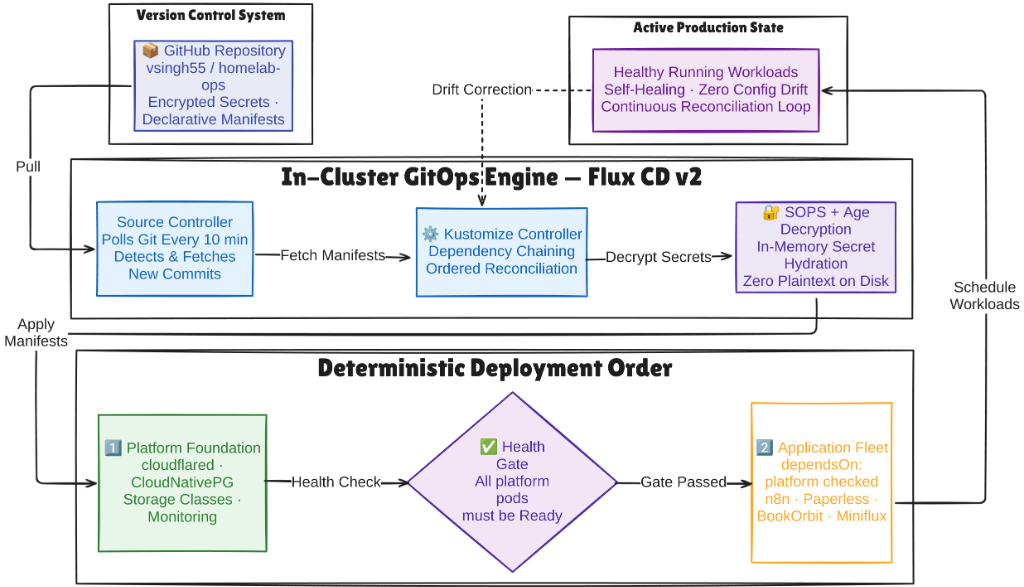
4. Key Architectural Implementations
1. In-Git Asymmetric Encryption with Mozilla SOPS & Age
Rather than storing whole encrypted blobs or relying on symmetric passwords:
- Developers encrypt secrets using the platform's public Age key (
age1...) defined in .sops.yaml. - SOPS encrypts strictly the YAML values, leaving object names, keys, and metadata in plain text for transparent code reviews and Git diff inspections.
- The private Age secret key (
AGE-SECRET-KEY-...) is injected into theflux-systemnamespace once during initial bootstrap and never leaves cluster memory.
# Repository SOPS Creation Rules (.sops.yaml)
creation_rules:
  - path_regex: kubernetes/.*\.enc\.yaml$
    encrypted_regex: "^(data|stringData)$"
    age: "age14g9mflspwt7n695jhe36873528t383g2v5u5c6y86p4mznv3g9ys4r6q0v"
2. Deterministic Stage Chaining (dependsOn)
To prevent startup race conditions, the root Flux configuration partitions delivery into structured dependency phases:
# Root Application Delivery (kubernetes/bootstrap/apps.yaml)
apiVersion: kustomize.toolkit.fluxcd.io/v1
kind: Kustomization
metadata:
  name: apps
  namespace: flux-system
spec:
  interval: 10m0s
  path: ./kubernetes/apps
  prune: true
  sourceRef:
    kind: GitRepository
    name: flux-system
  # Enforce platform readiness before application scheduling
  dependsOn:
    - name: platform
  # Enable in-memory SOPS decryption
  decryption:
    provider: sops
    secretRef:
      name: sops-age
Workloads in apps (such as n8n or Paperless) are held in pending state until the platform Kustomization (CloudNativePG operator, storage classes, cloudflared) reports healthy.
3. Continuous Self-Healing & Drift Neutralization
The Flux control loop continuously compares live cluster state against origin/main every 10 minutes (or immediately via GitHub push webhooks):
- If an unauthorized manual change is introduced via
kubectl, Flux immediately overrides the drift and restores the Git-defined configuration. - If a manifest is deleted from Git, Flux automatically prunes the corresponding Kubernetes resource from the cluster (
prune: true).
5. Verification & Operational Health
1. Flux Controller Health Audit
flux check
► checking prerequisites
✔ Kubernetes 1.30.0+k3s1 >=1.28.0-0
► checking controllers
✔ all desired controllers are healthy (source-controller, kustomize-controller, helm-controller)
✔ crds.kustomize.toolkit.fluxcd.io/v1 is up to date
2. Kustomization Reconciliation Status
flux get kustomizations
NAME         REVISION            SUSPENDED READY MESSAGE
flux-system  main@sha1:d4ba838   False     True  Applied revision: main@sha1:d4ba838
platform     main@sha1:d4ba838   False     True  Applied revision: main@sha1:d4ba838
apps         main@sha1:d4ba838   False     True  Applied revision: main@sha1:d4ba838
3. In-Memory Decryption Verification
# Verify decrypted secret in cluster memory
kubectl get secret -n database postgres-credentials -o jsonpath='{.data.password}' | base64 -d
ENC[AES256_GCM...]).
6. Quantified Engineering Impact
| Operational Dimension | Imperative Baseline (v2) | GitOps + SOPS (Current) | Engineering Yield |
|---|---|---|---|
| Configuration Drift | Frequent untracked manual edits | 0% Drift (Continuous Control Loop) | Immutable, Self-Healing Operations |
| Secret Storage Safety | Plaintext in memory / Local disk | Asymmetric In-Git Encryption (Age) | Zero Secret Leaks in Git History |
| Controller RAM Overhead | ~800MB–1.2GB (ArgoCD + Redis) | ~120MB (Flux CD v2 Controllers) | ~85% Memory Savings for Apps |
| Startup Race Conditions | Manual sequencing / Pod crash loops | Automated dependsOn Verification |
Zero Workload Boot Failures |
| Disaster Recovery Velocity | Hours of manual script execution | < 15 Minutes (Single Git Bootstrap) | Deterministic Point-in-Time Recovery |