01. System Architecture Overview
Platform Standard: Enterprise Sovereign Hybrid Cloud Architecture
Environment: Bare-Metal Hypervisor (Mumbai) + Multi-Cloud Support (OCI & GCP)
Operational Status: Production Reference Implementation
Target SLA: 99.9% Application Availability | RTO < 45m | RPO < 15m
1. Executive Summary
The homelab-ops platform is a production-grade, self-healing Sovereign Cloud Platform engineered to provide enterprise-standard digital services, workflow automation, document management, and private cloud infrastructure while operating under strict real-world engineering constraints:
- Carrier-Grade NAT (CGNAT) Traversal: Securely accepting external webhooks and public user traffic without exposing home router ports or leasing static public IPv4 addresses.
- Deterministic GitOps Continuous Delivery: Managing platform operators and applications declaratively with Flux CD v2 and Mozilla SOPS, eliminating manual configuration drift and keeping secrets encrypted in Git.
- Dual-Tier Hardware Economics: Overcoming disk I/O bottlenecks on a single Mini PC by partitioning high-IOPS NVMe flash for database engines and durable SATA mechanical disks for multi-terabyte media and document archives.
- Hybrid Multi-Cloud Resilience: Supplementing the on-premise sovereign cluster with cloud infrastructure across Oracle Cloud Infrastructure (OCI) and Google Cloud Platform (GCP) for out-of-band availability monitoring, remote state locking, and secondary cloud compute.
2. High-Level System Topology
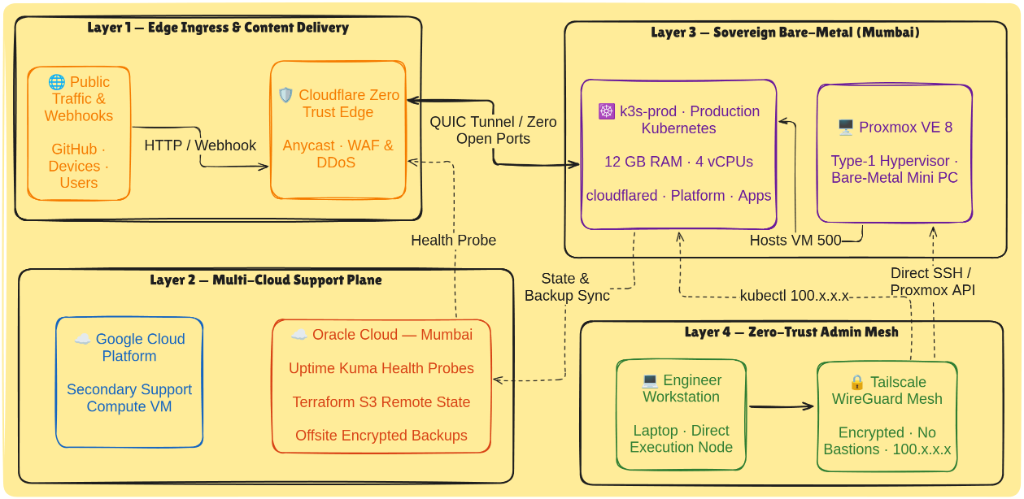
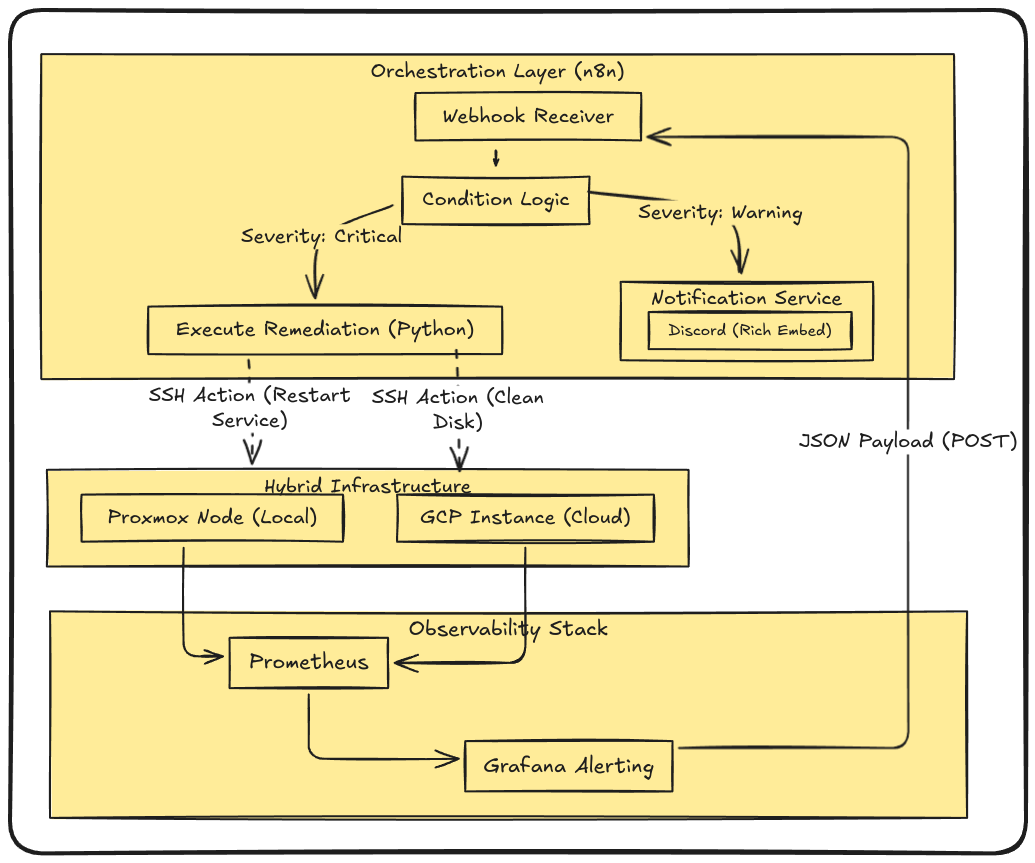
The global system architecture unifies external client traffic, edge security, cloud monitoring, administrative mesh networking, and on-premise Kubernetes compute into a cohesive, zero-trust infrastructure fabric:
3. Core Architectural Boundaries & Failure Domains
The platform enforces strict logical and physical boundaries between components to isolate failures and maintain zero-trust security:
| Architectural Domain | Location / Host | Primary Responsibilities | Network Isolation & Access |
|---|---|---|---|
| Public Edge Layer | Cloudflare Edge (Global Anycast) | SSL termination, DDoS protection, Web Application Firewall (WAF), Anycast DNS routing. | External Public Internet (HTTPS/QUIC) |
| Out-of-Band Cloud Plane | OCI Mumbai & GCP | External health probes (Uptime Kuma), S3 remote state locking, offsite encrypted backup replication. | Isolated Cloud VCNs / Dedicated Egress |
| Zero-Trust Management Mesh | Tailscale Overlay (P2P WireGuard) | Out-of-band administrative access directly from engineer laptop to Proxmox and K3s. | 100.64.0.0/10 Carrier-Grade Mesh |
| Bare-Metal Virtualization | Proxmox VE 8 (Intel i5 Mini PC) | Hardware virtualization, storage pool management, VM lifecycle, and host-level snapshot backups. | 192.168.1.0/24 Local Management VLAN |
| Application & Platform Plane | k3s-prod VM (K3s Kubernetes) |
Container orchestration, operator lifecycle (CloudNativePG), automated GitOps delivery (Flux CD v2). | Calico / Flannel Overlay CIDR |
4. End-to-End Traffic Lifecycles
Inbound Public Traffic Flow (Edge Ingress)
- DNS Resolution: Client queries
https://docs.vijaysingh.cloud. Cloudflare Anycast DNS resolves the domain to the nearest local edge PoP (<15ms latency). - Edge Security & SSL Termination: Cloudflare terminates TLS 1.3, executes Web Application Firewall (WAF) inspections, and mitigates L3/L4/L7 DDoS attacks.
- Outbound QUIC Tunnel: The in-cluster
cloudflareddaemon maintains an authenticated, outbound-only QUIC multiplexed tunnel with Cloudflare's Mumbai edge servers. - Local Cluster Ingress:
cloudflaredproxies the decrypted request directly to the in-cluster Traefik Ingress Controller. - Workload Delivery: Traefik matches the Host header and routes traffic over the cluster overlay network to the target pod service.
Administrative Traffic Flow (Zero-Trust Mesh)
- Workstation Authentication: Operator authenticates via Google Workspace Single Sign-On (SSO) and Multi-Factor Authentication (MFA) into Tailscale.
- Peer-to-Peer Encryption: Workstation initiates an end-to-end encrypted WireGuard tunnel (
100.108.178.93) directly to the Proxmox VE hypervisor or Kubernetes node. - Firewall Invariance: Zero inbound firewall rules are opened on the residential router. Traffic traverses NAT using authenticated Tailscale coordination servers and STUN NAT hole-punching.
Out-of-Band Observability Flow
- Synthetic Probes: An independent, isolated VM in Oracle Cloud Infrastructure (OCI Mumbai) runs Uptime Kuma, dispatching HTTP health probes to public edge endpoints every 60 seconds.
- Crash & Ingestion Monitoring: Within the on-premise cluster,
kwatchintercepts Kubernetes event streams (OOMKilled,CrashLoopBackOff) in real-time. - ChatOps Escalation: Status transitions immediately trigger formatted alerts to Slack
#homelab-alertsand Discord webhooks.
5. Architectural Trade-Off Analysis
| Decision Dimension | Selected Architecture | Alternative Evaluated | Trade-Off Rationale & Impact |
|---|---|---|---|
| Physical Hardware Density | Single High-Efficiency Intel i5 Mini PC | Multi-Node Bare-Metal Server Rack | Multi-node clusters require 200W–500W continuous power, generating thermal and acoustic noise. The single Mini PC draws ~15W idle (~$5/mo electricity), achieving high availability via CloudNativePG and automated GitOps disaster recovery. |
| Edge Ingress Model | Cloudflare Zero Trust Anycast Tunnels | Self-Hosted Cloud VPN Relay (GCP e2-micro) | The self-hosted cloud relay introduced ~45ms–120ms latency hops, single-point-of-failure VM dependencies, and recurring cloud egress costs. Cloudflare Tunnels cut latency to <15ms with zero open ports and zero recurring fees. |
| Configuration Management | Declarative GitOps (Flux CD v2) | Imperative Ansible Fleet Orchestration | Imperative Ansible playbooks require manual trigger and cannot prevent configuration drift between runs. Flux CD reconciles Git state every 5 minutes automatically. |
| Secret Management | In-Git Mozilla SOPS + Age Asymmetric Keys | Centralized HashiCorp Vault Cluster | HashiCorp Vault requires 1GB–2GB RAM, persistent unseal infrastructure, and operational maintenance. Mozilla SOPS allows encrypted secrets to be version-controlled in Git and decrypted in-memory by Flux. |
6. Enterprise Security & Defense-in-Depth Posture
+-------------------------------------------------------------------------+
| Layer 1: Public Perimeter (Cloudflare Edge Anycast, WAF, TLS 1.3)        |
+-------------------------------------------------------------------------+
                                    |
+-------------------------------------------------------------------------+
| Layer 2: Network Perimeter (Zero Inbound Ports, Outbound-Only QUIC)    |
+-------------------------------------------------------------------------+
                                    |
+-------------------------------------------------------------------------+
| Layer 3: Management Plane (Tailscale Mesh, Google SSO, MFA Required)   |
+-------------------------------------------------------------------------+
                                    |
+-------------------------------------------------------------------------+
| Layer 4: Kubernetes Control (Non-Root Containers, Read-Only Filesystems)|
+-------------------------------------------------------------------------+
                                    |
+-------------------------------------------------------------------------+
| Layer 5: Data Storage (In-Git SOPS AES-256 Encryption, Offsite Backups) |
+-------------------------------------------------------------------------+
7. Platform Verification Matrix
- [x] Edge Ingress endpoints respond with
HTTP 200over public Anycast. - [x] Zero inbound router ports forwarded across residential gateway.
- [x] GitOps continuous reconciliation active with zero drift.
- [x] Production database operates on automated WAL archiving and daily snapshot cycles.
- [x] Out-of-band monitoring active from independent cloud region.