Milestone v2.0: The Hybrid Cloud Relay Bridge (Legacy)
Platform Standard: Historical Architectural Baseline
Status: Deprecated (Superseded by Sovereign Cloud v3.0)
Original Timeframe: Milestone v2.0 Architecture
Key Technologies: GCP Compute Engine, WireGuard Site-to-Site, MinIO S3 Backend, Ansible Vault Hydration
1. Context & Objectives
To overcome the Carrier-Grade NAT (CGNAT) barrier without exposing residential router ports directly to the public internet, Milestone v2.0 established a Site-to-Site WireGuard Mesh extending the on-premise Proxmox cluster to a public cloud gateway hosted in Google Cloud Platform (GCP).
2. Legacy Architecture Topology
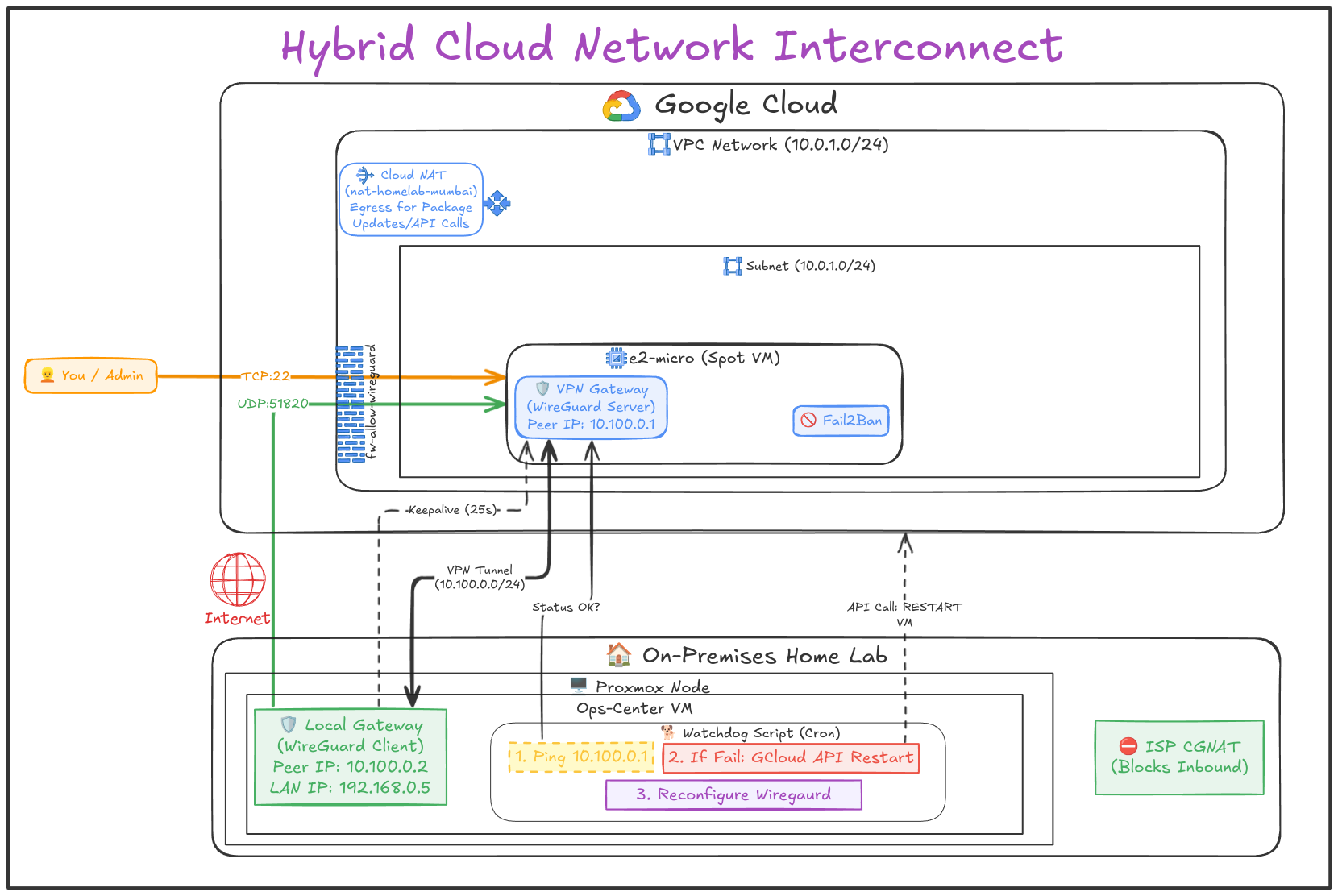
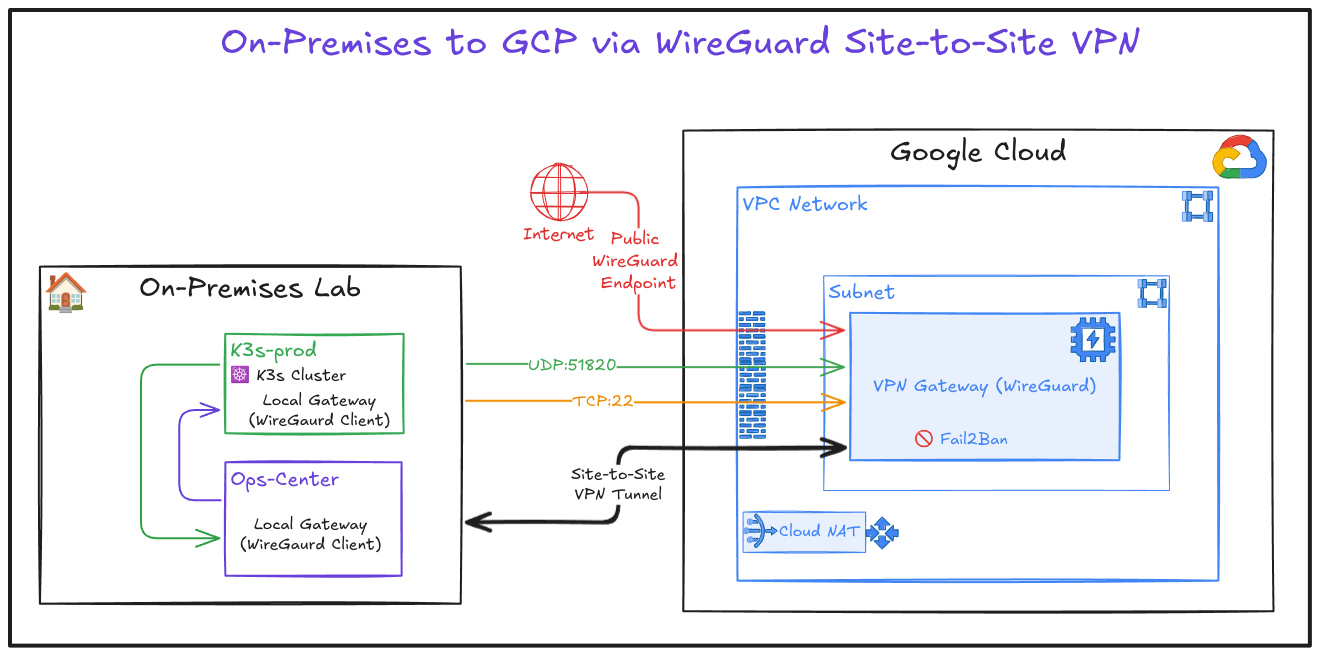
3. Implementation Stages & Failure Analysis
Stage 1: The "Direct Connect" Attempt (Rejected)
- Design: Router port-forwarding on residential router.
- Why Rejected: Severe security risk. Exposing the private home network directly violated Zero Trust principles and created a massive reconnaissance surface.
Stage 2: The "Split-Brain" Dynamic Cloud (Failed Experiment)
- Design: Provisioned GCP Spot VMs ($3/mo) paired with Dynamic DNS and custom bash watchdogs (
watchdog-vpn.sh) to detect preemption, recreate VMs, and rewrite Ansible inventory files withsed. - Failure Modes:
- DNS propagation delays (5–10 minutes) caused external webhooks to drop silently during preemption events.
- Ephemeral public IP reassignment broke Ansible static inventories with
Host Unreachableerrors.
Stage 3: The Stable Cloud Gateway
- Design: Provisioned a persistent GCP
e2-microinstance with a reserved static IP in GCP Mumbai (asia-south1). - Result: Eliminated the circuit-breaker issue. If the homelab went offline, the cloud gateway served a clean HTTP 502 Bad Gateway page instead of raw TCP connection timeouts.
4. Architectural Comparison: Milestone v2.0 vs. Modern v3.0
| Feature / Domain | Milestone v2.0 (Hybrid Cloud Relay) | Milestone v3.0 (Sovereign Cloud Platform) |
|---|---|---|
| Ingress Routing | Cloud Nginx VM -> WireGuard Tunnel -> On-Prem Traefik. | Cloudflare Anycast Global Edge -> Outbound QUIC Tunnel -> On-Prem Traefik. |
| Ingress Latency | ~45ms to 120ms (cross-network proxy hops). | <15ms Anycast edge termination in Mumbai/Delhi/Chennai. |
| Cloud Infrastructure Cost | ~$7.50 to $12.00 / month (VM compute, static IP, egress). | Zero recurring ingress costs (leveraging Cloudflare Zero Trust Anycast tunnels). |
| Secret Management | Ansible Vault + Jinja2 Just-in-Time hydration (hydrate_infra.yml). |
In-Git Mozilla SOPS encryption with Age asymmetric keys; decrypted in-memory by Flux CD. |
| Continuous Delivery | Imperative ansible-playbook & manual kubectl apply. |
Fully declarative GitOps continuous reconciliation via Flux CD v2. |
| Management Plane | Intermediate SSH Jump Host (ops-center VM). |
Direct Peer-to-Peer Tailscale WireGuard Mesh from engineer workstation to hypervisor. |
5. Architectural Decommissioning Rationale
While Milestone v2.0 successfully proved that hybrid cloud routing could bypass CGNAT, it carried high operational complexity:
- Recurring Infrastructure Overhead: Maintaining a 24/7 cloud compute VM, external static IP, and cloud NAT incurred ongoing cloud fees.
- Intermediate Bastion Overhead: Running
ops-centeras an intermediate SSH jump host and MinIO state server consumed 2GB RAM, 2 vCPUs, and 20GB NVMe storage on the physical host. - Double Ingress Complexity: Managing Nginx configurations in cloud VMs while simultaneously managing Traefik ingress definitions on-premise doubled the surface area for routing errors.
These pain points directly led to ADR-006 (Cloudflare Zero Trust Ingress), ADR-011 (OCI Multi-Cloud Hybrid Support Architecture), and ADR-015 (Decommissioning of ops-center in favor of Direct Operations).