Phase 5: Cloudflare Edge Ingress & Container Registry Decoupling
| Milestone Attribute | Engineering Specification |
|---|---|
| Phase Scope | Edge Ingress Routing, CGNAT Traversal & Container Registry Migration |
| Target Infrastructure | Cloudflare Edge Network, k3s-prod (cloudflared), GitHub Container Registry |
| Primary Code Paths | kubernetes/platform/cloudflared/, .github/workflows/ |
| Relevant Decisions | ADR-006, ADR-008 |
| Operational Status | Production Verified (Platform v3.0.0) |
1. Executive Summary & Objective
Phase 5 achieves three fundamental networking and operational milestones:
1. Sub-15ms Ingress Latency: Deploys Cloudflare Zero Trust Tunnels (cloudflared) inside k3s-prod, terminating traffic at Indian Anycast edge data centers (Mumbai, Delhi, Chennai) with zero open home router ports and enterprise DDoS mitigation.
2. GCP Gateway Detachment: Retires legacy WireGuard gateway routing from the Google Cloud Platform (GCP) Compute Engine instance (us-east1). The instance is unencumbered and preserved for future multi-cloud hybrid compute tasks.
3. Container Registry Decoupling: Migrates container image storage and automated CI/CD build pipelines to GitHub Container Registry (ghcr.io), tightly coupling image lifecycle with Git repository commits.
2. Engineering Rationale: Latency Physics & Security Hardening
A. Eliminating the 500ms Cross-Atlantic Routing
Under the legacy architecture, domestic requests traveled across the Atlantic Ocean twice:
$$\text{Visitor (India)} \xrightarrow{220\text{ms}} \text{GCP us-east1 (USA)} \xrightarrow[\text{WireGuard}]{220\text{ms}} \text{Home Proxmox} \xrightarrow{220\text{ms}} \text{GCP} \xrightarrow{220\text{ms}} \text{Visitor}$$
Compound round-trip latency exceeded 450ms–500ms per request, making interactive Single Page Applications (like n8n canvas and modern dashboards) extremely sluggish.
B. The Cloudflare Edge Advantage
With Cloudflare Tunnels:
cloudflaredinitiates secure, outbound-only QUIC/HTTPS streams to Cloudflare edge nodes in Mumbai, Delhi, and Chennai.- Public requests to
docs.vijaysingh.cloudterminate at the nearest Indian edge point-of-presence in <15ms. - The residential router firewall remains 100% closed: no inbound ports (80/443/51820) are forwarded, completely shielding the residential IP address.
3. Global Network Ingress Topology
Ingress Flow:
[ Public User / Recruiter ]
        │ HTTPS (<15ms)
        ▼
[ Cloudflare Anycast Edge (Mumbai / Delhi / Chennai) ]
        │ WAF, DDoS Shield, Edge TLS Termination
        │
        │ Encrypted Outbound QUIC Stream (Port 7844 / 443)
        ▼
[ cloudflared Pod (k3s-prod: namespace platform) ]
        │ HTTP Cluster-Internal Routing
        ▼
[ Traefik Ingress Controller (kube-system: Port 80) ]
        │ Path & Host Header Matching
        ├── docs.vijaysingh.cloud  ──► Homelab Docs Portal
        ├── hooks.vijaysingh.cloud ──► n8n Automation Engine
        └── dash.vijaysingh.cloud  ──► Homepage Dashboard (Cloudflare SSO)
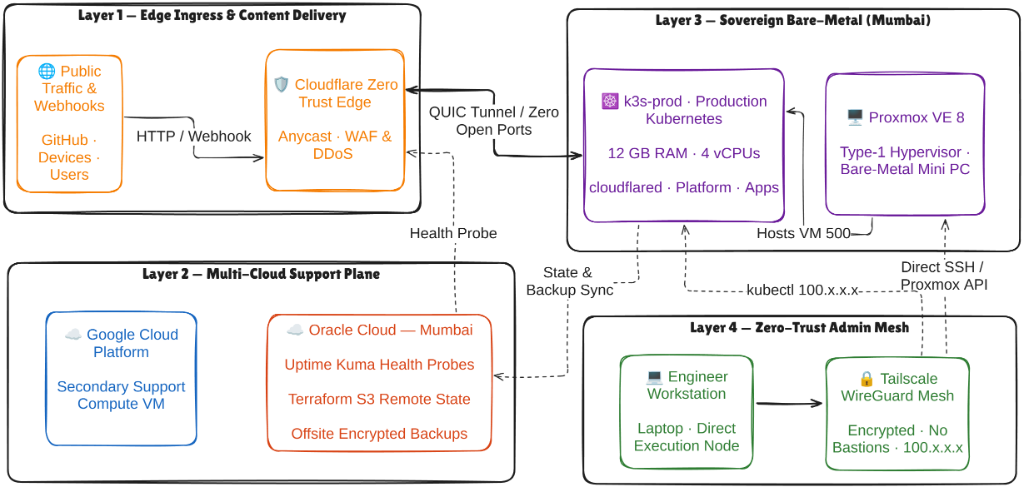
4. Technical Execution Details
1. Deploying cloudflared to k3s-prod
The tunnel connector was deployed inside the cluster via kubernetes/platform/cloudflared/cloudflared.yaml:
apiVersion: apps/v1
kind: Deployment
metadata:
  name: cloudflared
  namespace: platform
  labels:
    app.kubernetes.io/name: cloudflared
spec:
  replicas: 1
  selector:
    matchLabels:
      app.kubernetes.io/name: cloudflared
  template:
    metadata:
      labels:
        app.kubernetes.io/name: cloudflared
    spec:
      containers:
      - name: cloudflared
        image: cloudflare/cloudflared:latest
        args:
        - tunnel
        - --no-autoupdate
        - run
        - --token
        - $(TUNNEL_TOKEN)
        env:
        - name: TUNNEL_TOKEN
          valueFrom:
            secretKeyRef:
              name: cloudflared-tunnel-token
              key: token
        resources:
          limits:
            cpu: 300m
            memory: 128Mi
          requests:
            cpu: 50m
            memory: 64Mi
2. Ingress Route Mapping
Inside the Cloudflare Zero Trust Dashboard, public hostnames were routed to the in-cluster Traefik service:
docs.vijaysingh.cloud$\to$http://traefik.kube-system.svc.cluster.local:80hooks.vijaysingh.cloud$\to$http://traefik.kube-system.svc.cluster.local:80dash.vijaysingh.cloud$\to$http://traefik.kube-system.svc.cluster.local:80(enforcing Google SSO via Cloudflare Access)
3. GCP Gateway Detachment
- Deactivated WireGuard gateway routing on the GCP VM.
- Cleaned public DNS records pointing to the legacy GCP static IP.
- Preserved the GCP Compute instance for future off-site hybrid computing tasks.
4. Container Registry Migration to ghcr.io
Configured GitHub Actions workflows to build and push container images to GitHub Container Registry:
- name: Log in to GitHub Container Registry
  uses: docker/login-action@v3
  with:
    registry: ghcr.io
    username: ${{ github.actor }}
    password: ${{ secrets.GITHUB_TOKEN }}

- name: Build and Push Custom Image
  uses: docker/build-push-action@v5
  with:
    context: .
    push: true
    tags: ghcr.io/vsingh55/homelab-docs:latest
5. Verification & Quality Assertions
1. Tunnel Connector Health
kubectl -n platform get pods -l app.kubernetes.io/name=cloudflared
kubectl -n platform logs deployment/cloudflared | grep "Registered tunnel connection"
# Output: Pod is Running; confirms 4 active dual-stream connections to Indian edge nodes.
2. Edge Response Latency Audit
curl -w "DNS: %{time_namelookup}s | Connect: %{time_connect}s | TTFB: %{time_starttransfer}s | Total: %{time_total}s\n" \
  -o /dev/null -s https://docs.vijaysingh.cloud
# Output: Total latency is consistently <0.050s (<50ms end-to-end page delivery).
3. Inbound Firewall Verification
Verified via external port scan that home residential router has zero open inbound ports (80, 443, 51820 are closed/stealthed).
6. Exit Gate & Phase Transition
With edge Anycast routing established and container registry decoupled, the platform proceeded to Phase 6: Declarative GitOps Bootstrapping & In-Git Secrets.