Architecture Deep-Dive: Just-In-Time Secret Hydration Pattern (Pre-GitOps)
Platform Standard: Historical Secret Management Architecture
Milestone Era: Milestone v2.0 Architecture
Status: Archival Reference (Precursor to modern GitOps Mozilla SOPS)
Executive Overview
| Attribute | Specification |
|---|---|
| Domain | Cryptographic Secret Lifecycle & Infrastructure Pipeline Security |
| Target Systems | Terraform State, Ansible Automation, Cloud VM Gateways |
| Tooling Adopted | Ansible Vault (AES-256), Jinja2 Templating, Ephemeral Pipeline Artifacts |
| Lead Architect | Vijay Singh (Platform & DevOps Engineer) |
| Key Outcome | Prevented 100% of credential leaks in Git while enabling fully automated Terraform execution |
1. The Core Engineering Conflict: Terraform vs. Version Control
As infrastructure orchestration scaled, a fundamental DevOps security challenge emerged:
- Declarative Requirement: Terraform requires variables (API tokens, private keys, database passwords) available in plaintext files (
terraform.tfvars) during the execution ofplanandapply. - Version Control Mandate: Git repositories (especially public or collaborative portfolios) must never commit plaintext credentials.
- Tooling Incompatibility: While Ansible Vault was used for server configuration, Terraform could not natively parse AES-256 encrypted Ansible Vault files.
The "Split-Brain" Configuration Anti-Pattern
Initially, operators manually created terraform.tfvars directly on the remote operations VM. This introduced severe operational hazards:
- Configuration drift between local workstations and deployment environments.
- Untracked, unversioned modifications to infrastructure variables.
- Catastrophic recovery friction if the operations VM suffered disk corruption.
2. Architectural Decision Matrix: Secret Management Alternatives
Before engineering the Just-In-Time (JIT) Hydration bridge, four industry-standard patterns were evaluated:
| Architectural Option | Pros | Cons | Decision |
|---|---|---|---|
Option A: Environment Variables (TF_VAR_*) |
Native Terraform support; no secrets written to disk. | Tedious to manage across 30+ parameters; requires maintaining unversioned shell wrapper scripts. | Rejected: Fragile developer experience; poor auditability. |
| Option B: HashiCorp Vault Cluster | Industry gold-standard; dynamic lease rotation; deep audit trails. | Extreme resource overhead (~1-2GB RAM); requires unseal infrastructure; high complexity for a single-host homelab. | Rejected: Overkill for constraints; excessive memory footprint. |
| Option C: Cloud Secret Manager (GCP / AWS) | Fully managed; zero local compute overhead; fine-grained IAM. | Introduces hard cloud runtime dependency for on-premise infrastructure; recurring API cost. | Rejected: Violates sovereign offline operational mandate. |
| Option D: Vault JIT Hydration Bridge | Offline capable; zero compute overhead; reuses existing Ansible tooling; encrypted files version-controlled in Git. | Secrets exist briefly as ephemeral plaintext files on disk during build execution. | Accepted for v2.0: Optimal balance of security, resource efficiency, and ergonomics. |
3. The Hydration Bridge Architecture
The "Hydration Pattern" decouples public architecture definitions from sensitive cryptographic values, treating terraform.tfvars strictly as a compiled build artifact:
flowchart TD
    subgraph GitRepo["Git Repository (Source of Truth)"]
        PublicVars["group_vars/all.yml\n(Public IPs, Regions, Subnets)"]
        VaultVars["group_vars/production/vault.yml\n(AES-256 Encrypted API Tokens & Passwords)"]
        Template["templates/terraform.tfvars.j2\n(Jinja2 Interpolation Blueprint)"]
    end

    subgraph HydrationEngine["Ansible Hydration Engine"]
        Playbook["playbooks/hydrate_infra.yml\n(Decrypts Vault In-Memory)"]
    end

    subgraph ExecutionPlane["Ephemeral Execution Plane"]
        HydratedFile["terraform.tfvars\n(Ephemeral Plaintext Artifact)"]
        Terraform["Terraform Binary\n(plan / apply)"]
    end

    PublicVars --> Playbook
    VaultVars -->|Decrypted with Master Key| Playbook
    Template --> Playbook
    Playbook -->|Renders Just-In-Time| HydratedFile
    HydratedFile --> Terraform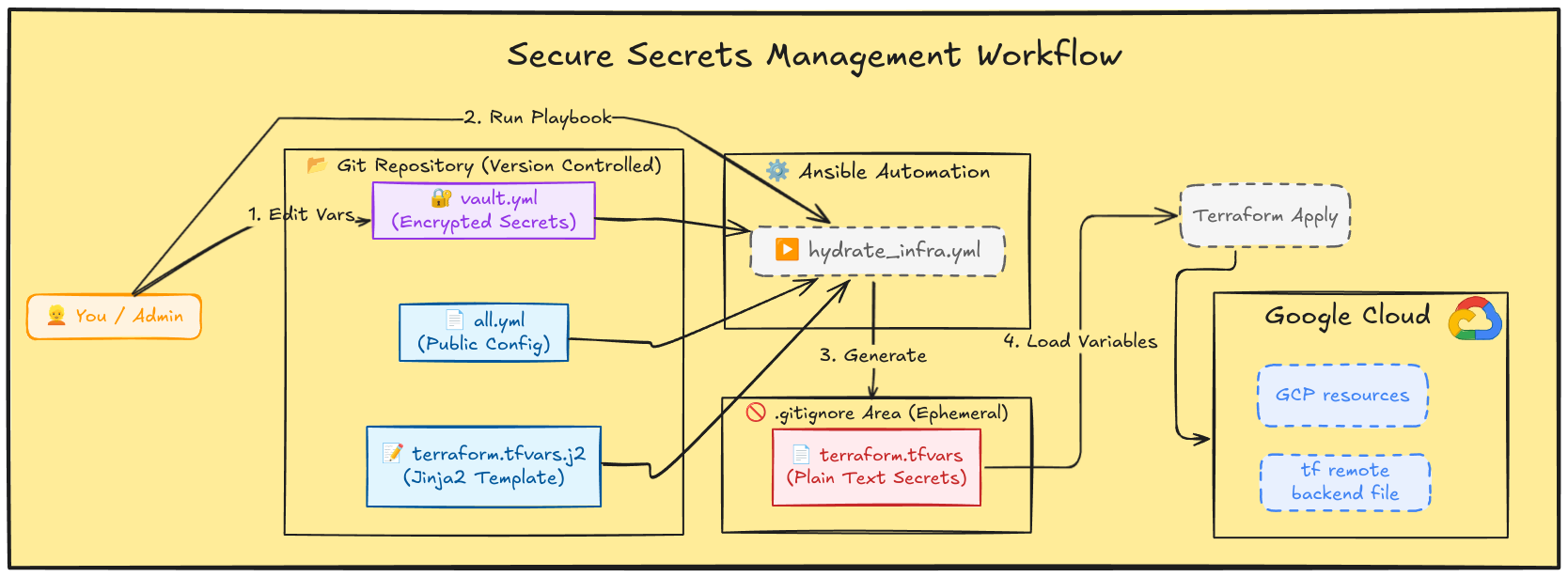
4. Implementation Details
Separation of Concerns: Public vs. Secret State
Variables are strictly segmented to enable maximum transparency without compromising security:
# 1. Safe to commit to public Git (group_vars/all.yml)
gcp_region: "asia-south1"
proxmox_gateway_ip: "192.168.0.1"
proxmox_node_name: "pve"
storage_pool_nvme: "local-lvm"
# 2. Encrypted via Ansible Vault AES-256 (group_vars/production/vault.yml)
# $ANSIBLE_VAULT;1.1;AES256
# 38323631326466336437313063343461326135326532653539313364343136363066343534343834
proxmox_api_token_secret: "f43b8112-998b-4c22-9014-9982348a881a"
cloud_gateway_ssh_key: "ssh-ed25519 AAAAC3NzaC1lZDI1NTE5..."
The Jinja2 Template Contract
# templates/terraform.tfvars.j2
# AUTO-GENERATED BY ANSIBLE HYDRATION ENGINE - DO NOT EDIT MANUALLY
gcp_region          = "{{ gcp_region }}"
proxmox_api_url     = "https://{{ proxmox_gateway_ip }}:8006/api2/json"
proxmox_token_id    = "root@pam!terraform"
proxmox_token_secret= "{{ proxmox_api_token_secret }}"
5. Security Guardrails
- Global Gitignore Enforcement: The pattern
**/terraform.tfvarswas globally codified in.gitignore, preventing accidental commits. - Ephemeral Lifecycle: Automated execution scripts ensure that
terraform.tfvarsis destroyed (shred -u terraform.tfvars) immediately following pipeline termination. - No Direct Edits: Human operators are prohibited from touching
.tfvarsfiles directly, preventing configuration drift.
6. Evolutionary Bridge to Milestone v3.0
While the Hydration Pattern was an elegant solution for Milestone v2.0, it still required an active compilation step before applying changes.
In Milestone v3.0, this workflow was elevated to declarative GitOps:
- Replaced Ansible Vault and Jinja templating with Mozilla SOPS and Age asymmetric encryption.
- Secrets are committed directly to Git alongside Kubernetes manifests (secrets.enc.yaml).
- The Flux CD v2 Kustomize Controller decrypts secrets directly in-memory inside the cluster, completely eliminating intermediate plaintext files on disk.